My Future DIL Handed Me a Mop in Front of 20 Guests at Her Bridal Shower and Told Me to ‘Earn My Meal’ – The Gift I Pulled Out of My Purse Made the Whole Room Gasp

At my future daughter-in-law’s bridal shower, I expected the usual — polite smiles, small talk, a few awkward pauses filled with laughter that doesn’t quite land. I did not expect to walk out of that room questioning everything I thought my son knew about the woman he planned to marry.
Daniel lost his father when he was eight. One day I was a wife and a mother, and the next I was figuring out how to survive on one income, how to stretch groceries, how to keep the lights on without letting him feel the weight of it. I took whatever steady work I could find. Cleaning jobs. Schools, offices, clinics. Wherever there were floors to scrub and trash to empty.
So when he called me months ago and said he was going to propose, I cried right there, standing over a bucket of floor cleaner. Not because of the wedding itself, but because it felt like proof that all those years had led somewhere good.
Emily had always been polite with me. Not warm, never quite open, but polite enough that I told myself it didn’t matter. My son loved her. That was supposed to be enough.
At the shower, she stood under a soft pink balloon arch, perfectly dressed, perfectly composed. When she saw me, she gave a brief smile and said, “You made it.”
“I wouldn’t miss it,” I replied, holding out the gift I had brought.
She took it lightly, almost absentmindedly. No hug. No thank you. Just a gesture toward a table.
I told myself not to read into it.
Then she clapped her hands to get everyone’s attention.
“Okay, ladies,” she said brightly, “before we eat, we’re doing something fun.”
She picked up a glass from the table beside her, turned slightly, and let it fall.
It shattered across the floor.
The room went still.
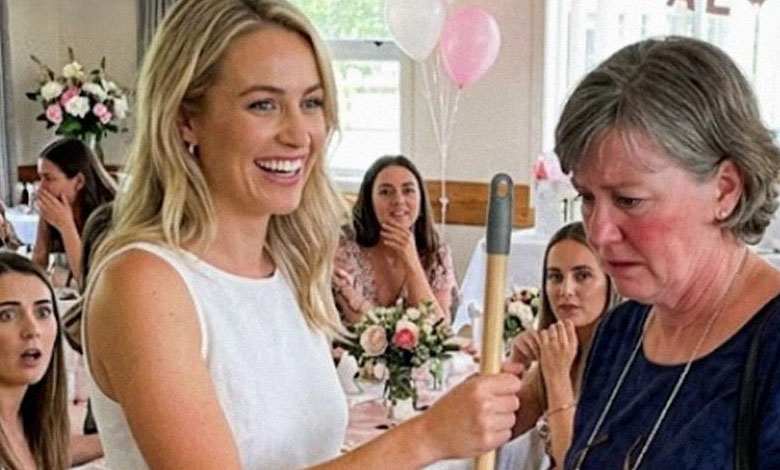
She bent, picked up a mop from near the catering station, and walked straight toward me — not toward the staff, not toward the host, but toward me.
Then she held it out.
“Since you didn’t contribute much, you can at least earn your meal. You should be used to this, anyway.”
For a moment, I didn’t move.
I could feel every set of eyes on me, waiting to see what I would do. But it wasn’t the silence that struck me. It was her expression.
She was enjoying it.
Not nervous. Not embarrassed. Not unsure.
Enjoying it.
That was when something inside me shifted.
I didn’t take the mop.
Instead, I set my purse on the table, opened it, and took out a small silver key tied with a faded blue ribbon.
“This was going to be your wedding surprise,” I said.
She frowned, confused.
“It’s the key to the condo Daniel and I have been saving for. The down payment was going to be my gift to the two of you.”
I felt the room change. The whispers. The realization spreading.
“I’ve spent nineteen years cleaning floors,” I continued. “Working double shifts. Skipping everything I didn’t absolutely need. Every extra dollar went into that. Not for recognition. For him. For his future.”
Then I closed my hand around the key.
“But gifts go where they’re valued.”
I picked up my coat and left.
I made it to my car before the tears came — not quiet ones, but the kind that shake you. I sat there gripping the steering wheel, trying to steady myself, reminding myself I would not let that moment break me.
Later, Daniel called.
He sounded tense, uncertain.
“Mom, what happened?”
I told him. Not everything at first. Just enough.
He hesitated. Said she told him it had been a joke. That I had misunderstood.
So I asked him one question.
“Did she tell you she handed me a mop and told me to earn my meal?”
Silence.
That silence said more than anything else could have.
The next morning, Emily showed up at my door without invitation. No soft voice, no polished manners. Just anger.
She told me I had embarrassed her. That bringing up the condo in front of everyone had been cruel.
I almost laughed at the word.
“Cruel,” I repeated.
She dismissed what she had done as a joke. Said I had taken it too personally. Then she crossed a line she could not take back — claiming I didn’t belong in their world, that I made things awkward.
I asked her to leave.
And then I called my son.
When Daniel came over that evening, he looked different. Tired. Older, somehow.
I told him everything. Not just the shower, but what she had said in my home.
He didn’t interrupt. Just listened.
When I finished, he sat there for a long time, staring at the floor.
Finally, he admitted what he had been avoiding. The small comments he had brushed off before. The moments he had explained away. He had seen it, but it had been easier not to name it.
I placed the key on the table between us.
“This isn’t about property,” I told him. “It’s about what it represents. I gave everything I could so you could build a life with someone kind.”
He started to cry — quietly, the way he used to when he was small.
“I’m sorry,” he said.
I didn’t rush to comfort him. Some lessons need to settle before they heal.
That night, he went to see her.
He asked her directly what had happened.
She called it a joke again.
But this time, she didn’t hide the truth behind it.
“Your mother came in there acting like she belonged.”
That was the moment, he later told me, when everything became clear.
Not anger. Not confusion.
Clarity.
He took off his engagement ring and left it behind.
When he came to my house that night, he looked like someone who had just walked away from a version of his life that no longer made sense.
“It’s over,” he said.
He sat at the same kitchen table where he used to do homework while I packed his lunch, and after a long silence, he said something I had been waiting to hear.
“I should have protected you.”
“I didn’t raise you to be ashamed of me,” I told him.
He shook his head.
“I’m not ashamed of you. I’m ashamed of me.”
The wedding was canceled. The plans unraveled. People talked. One woman from the shower even reached out to apologize, admitting that what happened had been planned in advance.
But what mattered most wasn’t what ended.
It was what changed.
Weeks later, we sat in a small diner he loved as a child. He handed me a small box.
Inside was a simple keychain, engraved with one sentence:
For the home you taught me to deserve.
I cried right there in the booth.
The condo key is still in my drawer, tied to that same faded ribbon.
Maybe one day I’ll give it to him.
But now I know something I didn’t fully understand before.
A person can spend a lifetime doing humble work and still carry more dignity than someone dressed in silk, holding a glass, trying to prove they’re above it.
And my son — finally — understands the difference.