In the middle of the night, a young girl called the police because her parents wouldn’t wake up—and what officers found at the house stunned everyone.

At exactly 2:17 a.m., the emergency line at 112 rang through the stillness of the control room.
The operator nearly let it pass for half a second longer than usual. Night shifts were full of prank calls, restless teenagers, and people with too much time and too little sense.
Then she answered.
And the moment she heard the voice on the other end, every trace of irritation vanished.
It was a child’s voice—small, shaky, barely loud enough to travel through the line.
“Ma’am… my mom and dad won’t wake up… and the house smells weird…”
The operator’s hand tightened around the receiver.
This was no prank.
“Sweetheart, can you tell me your name?”
“Sofia… I’m seven…”
“Okay, Sofia. You’re doing so well. Where are your parents right now?”
“In their bedroom… I tried shaking them… but they don’t move…”
A cold feeling settled in the operator’s chest.
She launched emergency protocol immediately. A patrol unit was dispatched to the address while she stayed on the line, forcing calm into her voice as she guided the child step by step.
“Sofia, I need you to listen very carefully. Take your stuffed animal if you want, and go outside. Don’t stay inside the house. Go into the garden and wait for the police there, okay?”
There was a pause, then the soft sound of a door opening.
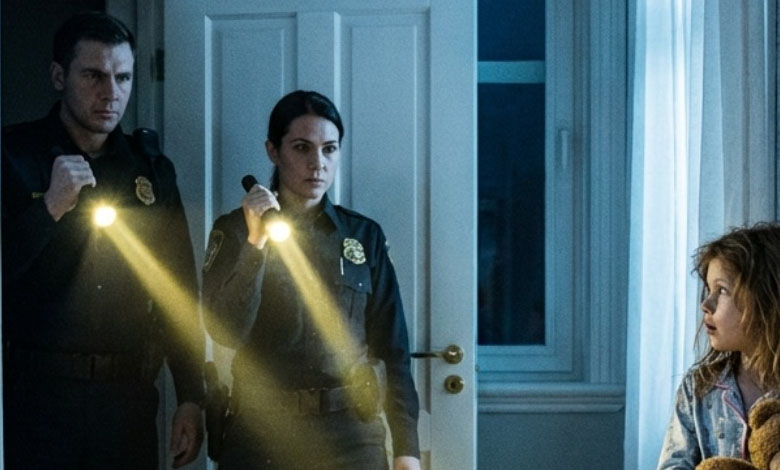
When officers arrived at the small wooden chalet near the edge of town, the scene stopped them cold.
Sofia sat barefoot on the ground, curled around a worn stuffed toy, her small shoulders rigid in the night air. Her eyes were red and swollen, but she wasn’t crying.
That was what unsettled them most.
Children her age usually cried.
This little girl looked as if fear had already passed through her and left something quieter—and stranger—behind.
As Officer Morales approached the front door, the smell hit him instantly.
Gas.
Strong. Sharp. Unmistakable.
But there was something else beneath it too, a faint metallic scent that made his stomach tighten.
He immediately radioed for the fire department.
Sofia spoke quietly as they moved around her, her voice flat with shock.
“A few days ago, my mom said the boiler was making weird noises…”
No technician had come. No one had treated it like an emergency.
Now the house stood before them like a sealed trap.
Wearing protective masks, the officers entered.
What they found inside was worse than they expected.
Sofia’s parents lay side by side on the bed, motionless. There were no signs of struggle. No blood. No overturned furniture. No broken glass.
Just two bodies barely breathing in a room heavy with poisoned air.
A smoke detector hung silent on the wall.
Its batteries had been removed months ago.
Paramedics evacuated them within minutes. The ambulance arrived with sirens cutting through the darkness as Sofia stood in the garden, staring at the open front door.
When they wheeled her mother past, she reached out instinctively.
“Are they going to wake up?” she asked, her voice barely above a whisper.
A nurse bent slightly toward her.
“We’re doing everything we can.”
But even as the paramedics worked, something about the scene bothered the officers.
The main gas valve was open far wider than it should have been.
And in the bedroom, the ventilation duct had been deliberately blocked with a towel jammed tightly in place.
Morales looked at his partner, his expression hardening.
“This wasn’t an accident.”
Sofia was placed temporarily in police care, small and silent in the back seat of the patrol car while the first pale hints of morning touched the sky.
At that moment, no one could have guessed that what happened in that house was not simply negligence, nor random malfunction.
It was the beginning of something far darker.
By dawn, Sofia’s parents were in intensive care, both suffering from severe carbon monoxide poisoning. Doctors said the exposure had been prolonged, meaning the gas leak had gone on for hours before Sofia made the call.
Meanwhile, forensic investigators combed through every corner of the chalet.
The towel blocking the ventilation had clearly been forced in from inside the bedroom. But the boiler itself told a different story. A technician studied the damaged parts, then straightened with a grim face.
“This didn’t fail on its own,” he said. “Someone tampered with these valves.”
When Morales later sat with Sofia in a quiet children’s room at the station, he kept his tone gentle. She answered with the shaky honesty of a child too young to understand how important every word had become.
“Yesterday, Dad was very nervous,” she said. “He was yelling on the phone. He said he couldn’t pay anymore.”
Morales wrote quickly.
“Did you hear who he was talking to?”
“No… but somebody told him he had until today.”
“Did men come to the house before?”
She nodded.
“For the past month. Mom said it was grown-up stuff.”
Morales exchanged a look with the social worker nearby.
Illegal lenders.
Loan sharks.
Families crushed by debt, then dragged deeper by threats.
At the hospital, Sofia’s parents remained unconscious, and by afternoon, the case had shifted from suspected accident to attempted homicide.
Then came the security footage.
A camera near the residential complex showed a hooded man approaching the family’s house at 11:46 p.m. His face was hidden, but one detail stood out immediately.
He limped slightly on his right foot.
Five minutes later, he reappeared, leaving quickly.
Too quickly for a stranger fumbling through a house for the first time.
But more than enough time for someone who already knew exactly where to go and what to do.
That evening, Morales returned to the chalet to recheck details that had seemed minor before. In the parents’ bedroom, he noticed a faint scuff on the doorknob, as if someone wearing rough gloves had gripped it tightly.
No forced entry.
No broken lock.
Whoever entered had done so easily.
“This was planned,” he muttered.
What he didn’t know yet was that the most important clue in the entire case wasn’t hidden in the boiler or the cameras.
It was under Sofia’s bed.
The next day, she was taken to a temporary foster home. She brought her backpack, her stuffed toy, and a small notebook. That night, while helping unpack her things, a caregiver opened the notebook and found page after page of drawings.
At first glance they looked ordinary.
Childish.
Simple.
But the more she turned the pages, the more unsettling they became.
In one drawing, several faceless men stood outside the house.
In another, Sofia’s father shouted into a phone while her mother cried in the kitchen.
And in the last drawing, there was something that made the caregiver call police immediately.
It showed Sofia in her bed, awake in the dark.
And on the stairs, descending toward the basement where the boiler was, stood a shadowy black figure.
When Morales arrived, he crouched in front of Sofia and asked softly, “Can you tell me about this drawing?”
She clutched her stuffed animal tighter.
“I heard footsteps,” she whispered. “Heavy ones. I thought it was Dad… but he was already in his room.”
“Did you see the person?”
“Only the shadow.”
“Before your parents went to sleep?”
She nodded slowly. “Yes… I think so.”
That changed everything.
If the intruder had been inside before the parents fell asleep, then he had not broken in.
Either he knew the house very well—
or someone had let him in.
Police recovered deleted messages from Sofia’s father’s phone. Among them was a conversation with a contact saved only as “R.”
The messages were short and brutal.
The deadline is tomorrow. No more excuses.
If there’s no payment, there will be consequences.
Then investigators examined the family’s bank account and found something even more disturbing: regular deposits from a shell company that was later linked to a violent extortion network operating through illegal loans.
The case widened quickly.
When police questioned the closest neighbor, Raúl Montenegro, his confidence crumbled almost immediately. Under pressure, he admitted that he had recommended Sofia’s father take the loan because he had seen “no other way out.”
Then he revealed something else.
“One of the men limped,” he said quietly. “On his right foot.”
Piece by piece, the truth took shape.
The intruder hadn’t come to negotiate.
He had come to punish.
Tampering with the boiler and blocking the ventilation created the perfect kind of attack—silent, efficient, and easy to mistake for an accident.
A warning.
A lesson.
A message to everyone who thought they could delay payment.
What no one had counted on was a seven-year-old girl waking in the night, smelling something wrong, seeing a shadow, and making a call that changed everything.
Three days later, her parents finally opened their eyes in the hospital.
When Sofia entered the room carrying a small bouquet of paper flowers made by hand, her mother burst into tears.
Her father, pale and weak beneath the hospital sheets, looked at his daughter with shattered eyes.
“I’m sorry,” he whispered. “For everything.”
By then, police already had a warrant for the limping man captured on camera. The case expanded into a regional investigation that began exposing an entire network of illegal lenders, threats, and violence hidden behind quiet neighborhoods and desperate families.
Sofia could not have understood all of that yet.
What she understood was simpler.
Her parents were alive.
She had saved them.
And although the road ahead would be difficult, the phone call she made at 2:17 that morning had done more than prevent two deaths.
It had pulled a buried truth into the light—
and forced everyone around it to finally see it.