My Daughter’s Teacher Turned Out to Be My Old Bully — And She Tried to Shame My Child in Front of Everyone

I used to believe that high school cruelty had an expiration date.
That once you graduated, the whispers, smirks, and hallway humiliations stayed locked in the past. Life, I thought, moves forward.
I was wrong.
It started on an ordinary afternoon. My daughter Lizzie came home, dropped her backpack by the kitchen table, and sighed in a way that didn’t match her usual after-school energy.
“We got a new science teacher,” she said.
“Exciting?” I asked lightly.
She hesitated. “It feels… personal.”
That word immediately set off alarms in me. Discipline isn’t personal. Teaching isn’t personal. But targeting someone? That is.
Over the next few days, she told me more. The teacher, Ms. Lawrence, made remarks about her appearance — her clothes, her hair — always loud enough for other students to hear. The comments weren’t direct insults, but they were sharp. Strategic.
And each time, there was laughter.
Not because the jokes were funny — but because teenagers often take cues from authority. When an adult models mockery, students follow.
I asked the question I was hoping not to need to ask.
“Does she do this to anyone else?”
Lizzie shook her head. “Just me.”
Over the next two weeks, I watched subtle changes in my daughter. She spoke less at dinner. She second-guessed herself constantly. Homework took longer because she kept rechecking everything.
Confidence doesn’t usually collapse all at once. It erodes quietly.
When I told her I would speak to the school, panic flashed in her eyes.
“Please don’t make it worse.”
That fear — the fear that standing up for yourself might backfire — felt painfully familiar.
Still, I requested a meeting with the principal.
Principal Harris listened carefully. She assured me the teacher had a strong record and promised to “look into it.” For a short while, things improved. The comments stopped.
But then the grading shifted.
Lizzie’s scores began slipping, despite her working harder than ever. When she asked for clarification, she was given vague answers. Sometimes she was questioned on material not yet covered.
It didn’t feel like academic rigor.
It felt like a trap.
Then came the mid-year science presentations — a major grade, with parents invited.
Lizzie was nervous, but determined. For two weeks, we transformed our dining table into a research station. Climate data, renewable energy debates, policy discussions — we prepared thoroughly. I quizzed her constantly, determined that no unfair question would catch her off guard.
Presentation night arrived.
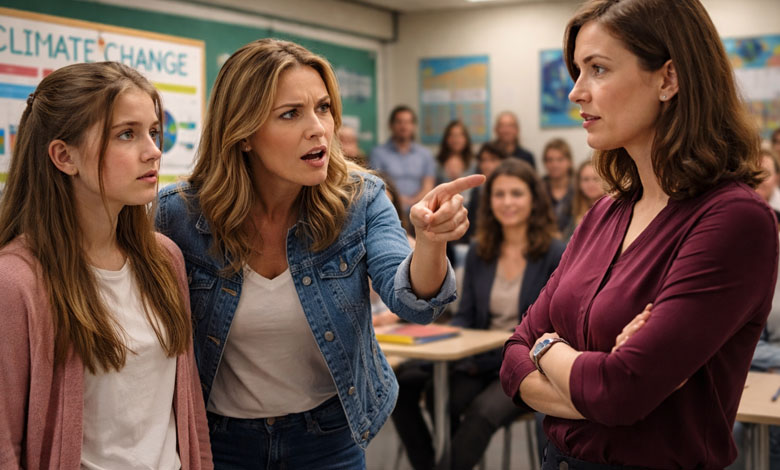
The classroom buzzed with families and tri-fold boards. And the moment I saw the teacher, something inside me tightened.
The eyes.
The expression.
Recognition hit both of us at the same time.
Ms. Lawrence wasn’t just my daughter’s teacher.
She was someone I had known before.
High school. Same graduating class. Same hallways where I had once tried very hard to be invisible.
She greeted me with a smile that didn’t reach her eyes. “What a surprise to see you.”
Lizzie delivered her presentation beautifully — confident voice, strong answers, clear understanding. The room applauded.
Then came the grading.
Several students who had clearly struggled received high marks.
When it was Lizzie’s turn, the teacher smiled thinly.
“A decent effort,” she said. “Though she’s slightly behind. I awarded her a B — generously.”
Then she looked directly at me.
“Perhaps she takes after her mother.”
It wasn’t subtle.
In that moment, I felt seventeen again.
But only for a second.
Because I’m not seventeen anymore.
I stood up.
“That comment was unnecessary.”
The room fell silent.
The teacher attempted to redirect. “If you have concerns, we can discuss them privately.”
“You brought my family into this publicly,” I replied calmly. “So let’s address it publicly.”
I explained that we had attended high school together. That there had been history. I didn’t dramatize. I simply stated facts.
Then I mentioned something else.
“I requested copies of Lizzie’s graded work. I compared her answers to the curriculum.”
I handed the folder to another parent nearby.
Within moments, murmurs began spreading across the room.
A mother spoke up. “My daughter said Lizzie gets questioned differently.”
Another student added, “She asks her stuff we haven’t learned yet.”
One voice turned into several.
Patterns that felt isolated suddenly looked visible.
The teacher tried to regain control of the room.
But before she could, Principal Harris stepped inside. She had been nearby and had heard enough.
After a brief, composed exchange, the principal announced that a formal review would begin immediately. The teacher would be placed on temporary leave pending investigation.
The atmosphere shifted instantly.
Outside, Lizzie looked stunned.
“What just happened?” she whispered.
“You were treated unfairly,” I said gently. “And it’s being addressed.”
On the drive home, she was quiet.
Then she asked, “She bullied you back then, didn’t she?”
I nodded. “Yes. But I didn’t want you carrying my past.”
She looked thoughtful. “When you stood up tonight… I felt stronger.”
That sentence mattered more than anything else.
Later that evening, after she went upstairs, I sat alone reflecting.
For years, those high school memories had lingered like unfinished business. Not because I wanted revenge — but because I had never spoken up.
Tonight wasn’t about settling old scores.
It was about protecting my child.
And maybe, in some small way, protecting the younger version of myself too.
Sometimes healing isn’t quiet.
Sometimes it stands up in a crowded room and calmly says,
“That’s enough.”