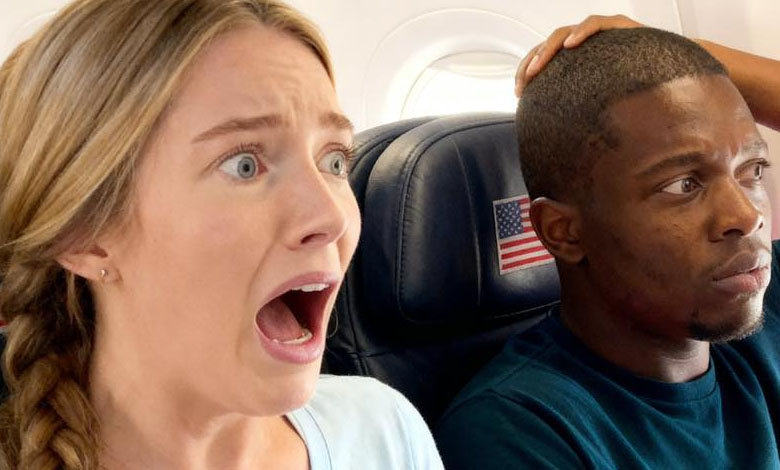
The overnight flight from Chicago to London carried 243 passengers across the Atlantic like a quiet secret.
Most of the cabin was asleep—heads tilted against headrests, thin airline blankets pulled up to chins, seatback screens throwing that soft blue glow onto faces that weren’t really watching anything. In 8A, a Black man in a wrinkled gray sweater slept with his temple pressed to the cold oval window, his reflection faint against the endless dark outside.
Nobody looked twice.
He was just another tired traveler, swallowed by engine hum and altitude and routine—thirty-seven thousand feet above the ocean, where the world below couldn’t reach you even if it wanted to.
Then the captain’s voice came through the speakers.
Not the usual polite announcement. Not the calm cadence of updates and time zones.
Sharp. Urgent. Too direct to ignore.
“If anyone on board has combat flight experience,” the captain said, “please identify yourself to the crew immediately.”
The cabin changed in a single breath.
Eyes opened. People sat up. The rustle of blankets and the click of seatbelts sounded suddenly loud. A baby began to cry somewhere near the back. A woman whispered a prayer in Spanish, the words quick and tight, like she was trying to keep fear from getting traction.
In 8A, the man opened his eyes.
His name was Marcus Cole.
Thirty-eight years old. Software engineer. Logistics company in downtown Chicago. A modest two-bedroom apartment in Rogers Park, close enough to the elevated tracks that the trains shook the windows like clockwork. Rent: $1,800 a month. Never late—not because he enjoyed paying it, but because that’s what responsible fathers did. You didn’t give the world extra reasons to come for you. You didn’t let your child see instability if you could help it.
His daughter, Zoey, was seven.
She had her mother’s wide brown eyes and her father’s stubborn chin. And she believed, with the unshakable certainty only children have, that her dad could fix anything—bike chains, school projects, fractions, broken hearts.
Her mother had died in a car accident when Zoey was three. Marcus had spent four years learning how grief fits inside everyday life: the empty chair at the kitchen table, the silence after a joke you can’t share, the way a child’s questions arrive like weather you can’t predict.
Every major choice he made led back to Zoey. He took the logistics job because it came with stability and health insurance. He turned down the promotion that would have swallowed his life with travel and seventy-hour weeks. He only took business trips when he couldn’t avoid them, and even then he called Zoey every night before bed, no exceptions.
Before boarding at O’Hare, he’d recorded her a voice message.
“Hey, baby girl. Daddy’s on the plane now. I’ll be home in two days. Be good for Grandma. I love you bigger than the sky.”
She always laughed at that line—bigger than the sky—because it belonged to them. It started when she was four, when she demanded a measurement for love and he pointed up at the endless blue and said it like it was fact.
Now, with the captain’s urgent announcement hanging in the air, Marcus felt the phrase return like a pulse.
Bigger than the sky.
He stared at the darkness outside his window and thought, not for the first time, that the sky had always been his first love.
Because Marcus hadn’t always been a software engineer.
Eight years earlier, he’d been United States Air Force.
He’d flown F-16 Fighting Falcons. Logged more than 1,500 hours. Iraq. Afghanistan. Missions that stitched themselves into your nervous system and never fully left. He’d earned a Distinguished Flying Cross for a night extraction that still returned in dreams like a rewind he couldn’t switch off.
He left because Sarah died.
A slick highway. Winter ice. A phone call at three in the morning that split his life into “before” and “after.” By sunrise, he was a widower, and a three-year-old was asking when Mommy was coming back, and his career required long stretches away from home.
He’d looked at the problem like a pilot looks at a failing system: brutally honest, no wishful thinking.
He couldn’t be both.
He couldn’t be a warrior and the kind of father Zoey needed.
So he resigned.
He remembered telling Zoey, even though she was too young to understand. He held her on his lap and explained that Daddy wasn’t going to fly the big planes anymore.
She had studied his face, then asked, confused and offended, “You don’t like the sky anymore?”
Something inside him had fractured that day—quietly, cleanly—like a bone snapping beneath skin.
“I like you more,” he told her. “I like you more than anything in the whole world.”
Now that buried part of him—the part that still understood turbulence by feel, the part that could read danger in the tone of an announcement—stirred awake.
A flight attendant hurried down the aisle, moving fast but trying to look calm. A businessman gripped his armrest until his knuckles turned white. Marcus glanced at his phone and saw Zoey’s last photo—gap-toothed grin in their small kitchen, hair slightly wild, joy unbothered by the world.
He had promised her he would come home.
He had promised.
The captain spoke again, tighter now.
“Ladies and gentlemen, I need to be more specific. We have experienced a critical malfunction in our flight control systems. If anyone on board has experience manually flying aircraft—particularly military or combat aviation—we need you to identify yourself to the cabin crew immediately. Time is of the essence.”
That wasn’t a minor issue. That was code.
Marcus’s mind snapped into that cold, precise focus he hadn’t used in years. A Boeing 787, he guessed from the cabin configuration. Fly-by-wire controls. Computers between pilot and control surfaces. Layers of redundancy, until redundancy started collapsing.
If enough of those systems failed, the plane didn’t become “difficult.” It became a brick with wings.
A man a few rows ahead stood up, waving like he was eager for attention.
“I’m a pilot!” he announced. “Private license, logged hours—”
Relief flashed across a flight attendant’s face as she hurried to him.
Marcus watched, concern tightening in his chest. A private pilot might be skilled, sure—but flying a single-engine plane on clear weekends wasn’t the same thing as facing cascading failures at altitude over the ocean. Not even close.
The flight attendant returned minutes later and shook her head. The man’s qualifications weren’t enough.
The air in the cabin thickened. People started looking around like they were waiting for someone else to save them.
Marcus sat there for one more beat, weighing the thing he always weighed.
Zoey.
If he stayed quiet, maybe someone else would step up. Maybe the crew would recover the system. Maybe luck would show up.
Or maybe the ocean would.
He unbuckled his seatbelt and stood.
He raised a hand.
“I can help.”
His voice came out quieter than he wanted, so he tried again, louder.
“I’m a former combat pilot. United States Air Force. Fifteen hundred hours in F-16s.”
Heads turned. People stared. Some looked hopeful. Some looked skeptical. Some looked at him like he’d just said he was from Mars.
A flight attendant approached. Her name tag read Jennifer. She was composed on the outside, but fear lived beneath her professionalism like a heartbeat.
“Sir,” she began, “do you have identification? Military credentials? Pilot license?”
“No,” Marcus said evenly. “I separated eight years ago. I don’t carry military ID.”
Jennifer hesitated, scanning him—wrinkled sweater, tired eyes, the ordinary look of a man who didn’t match the mental image people preferred for heroes.
He could see the doubt forming.
So Marcus did what he’d learned to do his entire life.
He didn’t argue feelings. He spoke facts.
“The aircraft is experiencing a cascading flight control failure,” he said quietly. “Based on the announcement, you’ve likely lost two of your three flight control computers. The fly-by-wire system is degrading. If the last computer drops, you’ll have no electronic control.”
Jennifer’s face went pale.
“Your only chance is standby control through the backup module. That requires training most civilian pilots don’t have.”
Behind Jennifer, someone muttered, just loud enough to land.
“He doesn’t look like a pilot.”
Marcus didn’t turn.
He’d heard versions of that sentence forever. At the academy. In briefing rooms. In stores where security followed him. In meetings where people assumed he was the assistant. He’d learned to let it pass through him and prove himself by action.
A woman stood up a few rows back. Calm. Controlled. The kind of calm that came from living around emergencies.
“I’m Dr. Alicia Monroe,” she said. “I don’t know flying, but I know trained professionals. He’s not panicking. He’s not performing. He’s analyzing.”
She looked at Jennifer. “That’s what real professionals do.”
A heavyset man in an expensive polo snapped back about protocols and credentials. His voice had that tone people used when they wanted authority without responsibility.
Marcus kept his voice level.
“The protocols are for normal emergencies. This isn’t normal. If I’m right, they may have twenty minutes before total loss of control. You can spend that time debating my sweater—or you can let me try to help.”
Jennifer lifted the intercom handset.
The answer from the cockpit came immediately.
“Bring him. Now.”
But as Marcus stepped into the aisle, a tall man blocked him. Close-cropped gray hair. Military posture. He said he was Navy, twenty-two years. He said he wasn’t letting anyone near the cockpit without proof.
Marcus met his eyes.
“Then test me.”
The man asked about manual reversion procedures, about flying without protections, about airspeed when data might be unreliable.
Marcus answered without hesitating.
“Fly by pitch, attitude, and power,” he said. “You don’t trust numbers when sensors are lying.”
The man watched him for a long moment, then stepped aside.
“He’s real,” he said quietly. “Take him up.”
As Marcus passed, the man caught his arm.
“Good luck,” he murmured. Then, softer, “And I’m sorry.”
Marcus understood. Not sorry for the test.
Sorry for the doubt.
“Thank you,” Marcus said, and kept walking.
The cockpit smelled like heat and stress.
Half the glass displays were dark or flickering. Warning tones chirped like anxious birds. The air carried the sharp bite of something overheated—burned plastic, maybe wiring.
The captain was slumped in the left seat, unconscious. A flight attendant knelt beside him with a cloth pressed to a gash on his forehead. Blood seeped into the fabric. The first officer, a young man named Ryan Cho, gripped the yoke like it was the only thing keeping reality in place.
Marcus didn’t waste time on dramatics.
“What happened?” he asked.
Ryan’s voice shook as he explained: the aircraft hit turbulence hard. The captain wasn’t strapped in. He struck his head. And they were already dealing with flight control failures when it happened.
Marcus scanned the panel. Two flight control computers showed failure. The third flickered—holding, but barely.
“We need to go standby,” Marcus said.
Ryan swallowed. “The checklist says it’s a last resort.”
“It’s not a last resort when the last computer’s dying,” Marcus replied. “It’s the plan.”
Ryan stared at the switch like it might bite him.
Marcus lowered his voice. “You’ve done it in the simulator. You know what comes next. Do it.”
Ryan disengaged autopilot. Verified hydraulics. Armed the standby module. And then his finger hovered.
Marcus put a steady hand on his shoulder.
“Just fly the airplane.”
Ryan flipped it.
For a moment, the controls went slack—dead. The aircraft shuddered and dropped. That sickening weightlessness hit Marcus’s gut like a memory.
Then the standby system caught.
The yoke stiffened. Response returned.
Ryan pulled gently. The nose came up. The aircraft steadied.
“It’s working,” Ryan whispered, like he didn’t dare believe it. “It’s working.”
Marcus didn’t celebrate. There was still work.
Nearest suitable airport?
Ryan checked. “Keflavík, Iceland.”
“How long?” Marcus asked.
“About two hours.”
Marcus’s eyes narrowed, already tracking the next threat. “Can this standby system hold two hours?”
Ryan didn’t answer right away, because the truth was obvious.
They didn’t know.
They diverted anyway, because sometimes you didn’t get perfect options—just the least terrible one.
In the cabin, word moved like electricity. Some passengers prayed. Some cried quietly. Some stared blankly at their screens as if pretending could change physics.
Dr. Monroe moved through the aisles, offering calm the way medics offered pressure to a wound.
But one man in first class—Carter Whitfield—made himself loud.
“They let some random guy into the cockpit,” he scoffed. “Some guy off the street.”
Dr. Monroe responded firmly. The crew tried to keep him quiet.
And then Carter said it—the thing that wasn’t about aviation at all.
“A Black guy in coach claiming to be a fighter pilot? Come on.”
Silence hit the cabin like a slap.
Even through the cockpit door and the intercom bleed, Marcus heard it.
His hands didn’t shake. His voice didn’t change.
But something inside him hardened—not because he doubted who he was, but because he hated that the world still tried to make excellence look suspicious when it came in the “wrong” package.
Then Ryan’s voice tightened.
“Marcus… hydraulic pressure is dropping.”
Marcus checked the indicators. Slow decline. Steady. A leak or a system overworking.
“At this rate,” Marcus said, doing the math in his head, “we’ve got about ninety minutes before we hit minimum.”
Ryan went pale. “That’s not enough to reach Keflavík.”
“No,” Marcus agreed. “It isn’t.”
He looked at Ryan, then back at the instruments, then at the darkness outside.
“I need the controls,” Marcus said.
Ryan hesitated—because rules existed for a reason, and this broke all of them. A passenger didn’t fly a commercial jet.
But rules also didn’t keep planes in the air when systems failed.
Ryan nodded, voice tight. “You have the aircraft.”
“I have the aircraft,” Marcus confirmed.
He slid into the left seat. The captain’s seat. The place he hadn’t allowed himself to sit in years, in any form.
The 787 was massive compared to an F-16, but the truth under all flying was the same: attitude, power, control response, and staying ahead of the aircraft.
The controls were already heavy. They would get heavier.
They needed a runway. Soon.
Ryan relayed bracing instructions to the cabin. The plane began its descent.
Out of the darkness, the runway lights finally appeared—thin lines of white and amber cutting through the night.
Marcus guided the approach, hands burning, forearms tightening as the control response grew stubborn.
This wasn’t graceful. This wasn’t textbook.
This was survival.
At low altitude, with failing hydraulics, finesse wasn’t available anymore. Marcus chose a landing profile he knew from a different life—one meant for bringing a damaged aircraft down when “perfect” was a fantasy.
“Brace. Tell them to brace,” Marcus said.
Ryan grabbed the PA.
“Brace for impact. Brace for impact. Brace for impact.”
The runway rushed up.
Marcus hauled the yoke with everything he had. The nose rose, slowly, grudgingly.
The main gear hit hard.
A bounce—one heartbeat of terror—then the aircraft settled, tires screaming.
Marcus engaged maximum reverse thrust. Brakes. Everything.
The aircraft shuddered violently. The end of the runway approached too fast.
For a moment, it felt like the whole plane was a living thing fighting him.
Then—slowly—speed bled away.
Eight thousand feet.
Six.
Four.
Two.
One.
And then the aircraft rolled to a stop.
Silence.
Then sound exploded behind the cockpit door—crying, laughter, prayers spoken into shaking hands. Strangers grabbing strangers like they’d known each other for years.
Jennifer reached the cockpit with tears on her face.
“Everyone is okay,” she said, breathless. “Everyone is okay.”
Marcus closed his eyes and saw Zoey’s smile like it was painted on the dark.
“I’m coming home, baby girl,” he whispered. “I’m coming home.”
They evacuated in controlled lines down emergency stairs into cold Icelandic air. Emergency vehicles flashed red and blue across the tarmac. Medical crews rushed the captain to a stretcher.
Marcus stepped out last.
A Black man in a gray sweater walking down from the cockpit of a commercial airliner—alive proof that whatever people expected had nothing to do with what was true.
Ryan told officials what happened, voice firm now.
“He did what no one else could,” Ryan said. “He flew that plane when it was barely controllable. He landed it when landing should have been impossible.”
People reached for Marcus as he walked toward the terminal. Some touched his arm. A woman pressed a rosary into his hand. Others just nodded, eyes wet.
Carter Whitfield stood apart, smaller now. The arrogance had drained out of him like blood from a cut.
When Marcus passed, Carter cleared his throat.
“I owe you an apology,” he said quietly. “What I said… it was wrong.”
Marcus looked at him once. Not cruelly. Not triumphantly.
Just tired.
“Thank you,” he said simply. “Learn from it.”
Then he walked on, because there was one voice in the world that mattered more than anyone else’s.
He found a quiet corner in the terminal and called home before his phone died.
Zoey answered, voice thick with sleep.
“Daddy?”
“I’m okay, baby girl,” Marcus said softly. “There was trouble with the plane, but everyone’s safe. I’m in Iceland.”
“Iceland?” she murmured. “That’s where the Vikings came from.”
Marcus laughed, the sound breaking into something that almost became tears. “That’s right. That’s exactly right.”
A pause.
“Daddy… were you scared?”
Marcus thought about the cabin. The doubt. The failing systems. The runway lights.
“A little,” he admitted. “But I had something to come home to. I had you.”
“I’m glad you were there,” Zoey whispered, already drifting. “I’m glad you helped the people.”
“Me too, baby girl,” he said. “Me too.”
He stayed on the line until her breathing deepened again, then sat back and watched Icelandic dawn creep across the windows.
Later, Dr. Monroe found him with two cups of coffee.
“I’ve been a doctor for twenty years,” she said. “I know what it looks like when someone is steady in the middle of chaos. What you did… that wasn’t luck.”
Marcus stared into the coffee like it had answers.
“I just did what I was trained to do,” he said.
She shook her head. “You stood up when people weren’t even seeing you. You didn’t ask permission to be capable.”
Marcus didn’t argue, because a part of him knew that was true.
The doubt hadn’t been new. The sky hadn’t been new. What was new was the way those two things had collided—and the way he’d still done what needed doing.
When he finally got back to Chicago, Zoey came running in the airport like a small storm.
“Daddy! Daddy!”
He dropped his bag and lifted her into his arms so hard she squealed.
“You’re squishing me!”
“I know,” he said, and didn’t let go right away.
That night, after bedtime stories and the familiar routine, Marcus sat at the edge of her bed and watched her sleep.
He thought about the promise he’d made eight years ago—to give up the sky so he could be the father she needed.
He had kept that promise.
He’d traded wings for stability. Thrill for safety. Altitude for bedtime.
But he understood something now with a calm certainty.
The promise had never been about staying grounded.
It had always been about coming home.
He kissed Zoey’s forehead, soft and warm beneath his lips.
“Sleep tight, baby girl,” he whispered. “Daddy’s home. Daddy will always come home.”
Outside the window, the stars hung bright and indifferent—just as they always had—watching over the world of people who doubted, people who saved, people who learned too late, and people who kept promises even when the sky demanded everything.