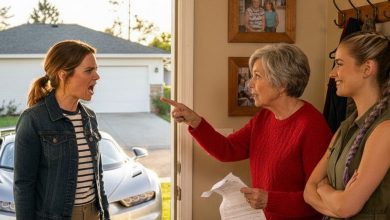
My mom noticed a faint perfume scent lingering on my dad. She didn’t mention it right away, but a few days later, she saw glitter on his shirt and a hairpin tucked into his pocket. That’s when she lost it and confronted him. He smiled and said, “I have something to tell you.”
Her hands were shaking. She told me later she had prepared for this moment for years, but it still hit like a punch to the gut. For a second, she thought he was going to confess to an affair.
Instead, he took a deep breath and said, “I’ve been taking dance classes. For her.”
He pointed to me.
I was fifteen then. Shy, awkward, and grieving. My school had announced a father-daughter dance for the spring fundraiser. My dad had seen the flyer on the fridge weeks ago. I never brought it up because I assumed he wouldn’t want to go.
“I didn’t want to embarrass her,” he told my mom. “So I’ve been taking private lessons after work. That’s where the glitter came from—ballroom studio. The hairpin belongs to the instructor. She asked me to hold it once during a spin and I forgot it was still in my jacket.”
My mom just stood there, blinking. My dad laughed nervously and said, “I swear, I should’ve just told you from the start. But I wanted it to be a surprise.”
It took a few minutes before Mom believed him. She grilled him with questions—who was the instructor, where was the studio, what dances had he learned. My dad answered every one, even demonstrated a stiff little waltz in the kitchen.
I didn’t find out about any of this until a week later, when he finally asked me to the dance.
We danced that night. Badly. But together. And while it wasn’t the most elegant thing, it was one of the happiest memories of my teenage years.
I thought that moment was the big twist in our family. The secret dance lessons, the misunderstanding, the kitchen waltz. But it was only the beginning.
Years passed. I moved out for college. Life became busier. My parents settled into a routine, and nothing dramatic ever seemed to happen again.
Until I came home one weekend and noticed my mom was different.
She was quieter than usual. Distracted. She burned the rice, which never happened, and kept checking her phone. My dad was cheerful, cooking dinner, humming to himself like nothing was wrong.
When I asked my mom what was up, she shrugged and said she was just tired.
But something didn’t sit right. That night, while Dad was out walking the dog, I saw her phone light up on the table. A message popped up from a contact named “M.”
The message just said, “Same time next week?”
I didn’t mean to snoop, but I did. I tapped on the thread.
It was a long list of conversations with someone named Marcus. They were mostly about art—gallery visits, sculptures, something about a pottery class. Nothing romantic, but definitely secret.
I confronted her the next day. I wasn’t angry, just confused.
She sighed. “It’s not what you think.”
“Then what is it?”
“I’ve been taking art classes. With Marcus. He’s 68 and missing a thumb, and he’s the best pottery teacher I’ve ever met.”
“Why didn’t you tell Dad?”
She hesitated. “Because… I needed something just for me.”
At first, I didn’t get it. But the more she talked, the more I understood.
“When you kids left, and your dad settled into his hobbies, I felt… invisible,” she said. “So I started painting again. I joined a little community group. That’s where I met Marcus. He’s a retired art teacher. We meet at the community center every Tuesday. He’s harmless, but I didn’t want your father thinking anything strange.”
I promised I wouldn’t say anything.
But I didn’t have to.
Because two weeks later, my dad walked into the community center with a bag of sandwiches.
He had figured it out. Not because of perfume or glitter, but because she kept coming home with paint on her sleeves. One night he followed her—not out of suspicion, but curiosity.
When he saw her sculpting a lopsided vase and laughing with a bunch of retirees, he said he felt relief. And a little proud.
“I always knew your mom had more talent than she let on,” he told me.
He kept her secret, too. Pretended he had no idea. Brought her flowers the next week, said they were “just because.” She never told him she knew he knew. It became their silent understanding.
I watched them grow into this quiet rhythm of unspoken support. It wasn’t loud or dramatic. It was ordinary. But it was beautiful.
Then came the real twist.
My dad’s company downsized, and he took an early retirement. At first, he was thrilled—more time for bike rides, reading, maybe a trip or two.
But six months in, he was restless.
“Your mother has her art,” he told me. “What do I have, really?”
“You could volunteer,” I suggested. “Or teach something?”
He shook his head. “I don’t know what I’d teach.”
A few days later, I got a call from him. He sounded breathless.
“Guess what?” he said. “I signed up for a mentorship program. Teaching dance.”
I almost dropped my phone.
“You’re teaching what?”
“Ballroom. Remember the lessons I took for you? Turns out I’m pretty decent. They need more male mentors at the studio. I start next week.”
And he did. Twice a week, he’d go teach older teens—kids without dads, kids from group homes—how to waltz, foxtrot, and sometimes just how to talk to someone with kindness.
He started glowing again.
My mom would pack him snacks. She’d wait for him to come home with stories. Then, in their living room, they’d dance together again. Just like they used to.
But this story wouldn’t be complete without one last shift.
My younger brother, who had always been the quiet one, called one night with news.
“I got fired,” he said.
He’d been working at a tech startup. Burned out. Unmotivated. Feeling stuck.
I asked if he was okay.
“Not really. But I’ve been thinking… I want to do something different.”
I braced myself.
“I’m going to culinary school.”
That caught me off guard. “Since when do you want to cook?”
“Since I watched Dad making dinner every night and realized it was the only part of my day that made me feel calm.”
He moved back home for a few months. My parents didn’t hesitate. They turned the guest room into a mini dorm. Dad became his unofficial sous-chef. Mom painted food still-lifes for practice and pinned them on the fridge.
The house smelled like garlic and butter and change.
And it worked.
My brother graduated top of his class two years later. He started a little weekend café with a few friends from school. Nothing fancy, but warm and full of regulars. He named it Spoons & Sundays.
It had a shelf with books. A wall for community art. And every Sunday afternoon, they cleared the middle of the room for dancing.
No one knew the real story behind that tradition—except us.
A few years later, we threw a party for my parents’ 35th anniversary.
Friends came. Neighbors, too. Even a few of Dad’s former dance students showed up. Mom wore a dress she painted herself—sunflowers on a navy background. Dad wore his old dance shoes.
At one point, they played their song. “Moon River.” And without a word, my dad offered his hand.
She took it.
They danced. Not like professionals. Not even like amateurs. But like two people who had kept choosing each other, again and again, through secrets, surprises, and silent understanding.
Everyone clapped. Some teared up.
Later that night, my mom pulled me aside.
“You know,” she said, “sometimes people think love is this big, dramatic thing. But most of the time, it’s quiet. Like packing someone’s lunch or pretending not to know their secrets just to protect their joy.”
I nodded.
She smiled. “Your father never asked about Marcus. But he built me a shelf for my sculptures.”
Here’s the thing.
Life doesn’t always come with fireworks. Sometimes it gives you glitter on a shirt and a hairpin in a pocket, and you assume the worst.
But sometimes, it’s just someone learning how to dance for the first time at 50. Or someone molding clay because they forgot what their hands were good at. Or someone deciding it’s okay to start over—whether it’s career, passion, or purpose.
We often search for grand gestures. But the real stories? They hide in the mundane. A burnt pot of rice. A Tuesday pottery class. A father learning how to waltz because his daughter might say yes.
This isn’t a story about betrayal.
It’s a story about how people surprise you. Even the ones you’ve known your whole life.
And how love—real love—grows when no one’s watching.
So if you’re reading this, wondering if it’s too late to take that class, send that message, or try that thing that’s been tugging at your heart—maybe it’s not.
Maybe your story’s just getting interesting.
And who knows?
Maybe someone’s already building a shelf for you.
If this story made you smile, please give it a like and share it with someone who believes in second chances and quiet love.